



National Survey on Lupus Report: Part Two
Health Care Experiences and Unmet Needs of People Living with Lupus in Canada: Findings from ACE’s Patient-Led Survey


Report highlights
- Reproductive health and family planning
- Pregnancy experiences
- Sexual health and intimacy
- Mental health and emotional wellbeing
- How can survey findings guide us
In the Part 1 reporting of the National Survey on Lupus, co-developed by Arthritis Consumer Experts (ACE) and Lupus Canada, people living with lupus in Canada described the long and often difficult path to diagnosis, challenges accessing care, and the daily burden of managing a complex autoimmune disease.
This JointHealth™ insight explores Part 2 findings across three areas that respondents said have a significant impact on their lives yet are often insufficiently addressed in their care: mental health, reproductive health, and sexual health and intimacy.
These are not secondary concerns. They shape how people make decisions about their futures, how they experience relationships, and how they cope with the uncertainty of living with lupus. Yet the survey findings suggest that these aspects of care are not routinely integrated into clinical practice, leaving many patients to navigate them largely on their own.
A consistent pattern emerges
Across all three domains – mental health, reproductive health, and sexual health and intimacy – a clear and consistent pattern emerges:
- A significant proportion of respondents reported unmet needs in areas that directly affect quality of life. Nearly one in four (24%) respondents did not receive reproductive health guidance from their health care providers, despite being receptive to the information.
- Four in five respondents (80%) reported experiencing anxiety, depression, or insomnia related to their lupus, while only 39% had sought out support from health professionals and family in the past year.
- Sexual health was also widely affected. Only 21% of respondents reported no impact on their sexual wellbeing, indicating that for most, lupus influences intimacy in meaningful and often complex ways.
Taken together, these findings point to a disconnect between what patients experience and what is routinely addressed in their care.
Reproductive health and family planning
For many people living with lupus, decisions about pregnancy and family planning are shaped by medical complexity, uncertainty, and risk. Clinical guidelines for managing lupus highlight that pregnancy in lupus often requires careful planning, including managing disease activity and medications to reduce risks for both mother and baby.1
Despite this, the survey findings suggest that reproductive health is not consistently integrated into lupus care.
Among respondents for whom reproductive health was relevant, nearly one in four (24%) reported not receiving guidance related to family planning or pregnancy. This gap is significant given the importance of disease stability, medication management, and timing in pregnancy outcomes. Research has shown that reproductive health is not consistently addressed during lupus clinic visits, with many patients reporting that these discussions do not occur unless they raise them themselves.1 The result is that patients are often left to make complex and high-stakes decisions without structured clinical support.
Pregnancy experiences: Navigating risk and uncertainty
While most respondents were not pregnant or planning pregnancy at the time of the survey, those who had experienced pregnancy described a wide range of outcomes, often shaped by the unpredictability of lupus.
Ten percent of respondents reported that lupus had a significant impact on their pregnancy, while an additional eight percent reported a moderate impact. These figures represent a meaningful group of patients for whom pregnancy is medically and emotionally complex.
Respondents described managing disease flares, fatigue, infections, and vascular disease during pregnancy, alongside the normal demands of pregnancy itself. Others reported serious complications, including miscarriage, clotting disorders, and preterm birth.

Patient challenges when making life-changing decisions about pregnancy
The survey findings suggest that reproductive health is not yet treated as a routine component of lupus care. Without early and proactive discussions, patients are left to navigate complex decision about pregnancy, medications, and timing with limited support.
Pregnancy was frequently described as high-risk, requiring close monitoring, frequent specialist visits, and, in some cases, hospitalization. For some, accessing appropriate care required travelling long distances to specialized centres, adding logistical and financial strain to an already demanding experience.
Additionally, several respondents reported that lupus symptoms were present during pregnancy but not recognized at the time, with diagnosis occurring only after complications arose, highlighting missed opportunities for earlier identification and coordinated care. These findings are consistent with lupus research showing that people with lupus often approach pregnancy cautiously, balancing personal goals with concerns about disease activity, medication safety, and potential outcomes for both mother and child.²
What people told us
Survey responses illustrate this complexity. Some respondents described managing disease flares, fatigue, infections, and vascular disease during pregnancy. Others reported serious complications, including miscarriage, clotting disorders, and preterm birth.
Physical symptoms and flares during pregnancy
Respondents described flares, rash development, vascular disease affecting blood vessels (arteries and veins), and severe fatigue:
“Living with pain, other auto immune diseases, exhaustion.”
– Woman diagnosed with SLE between 11-20 years old living in a large urban centre
“I started getting rashes on my chest and was mentally absent at times. There were moments when I couldn’t see anything. I went to the ER often, but no one could find anything. It was only after giving birth and going back to the ER that they discovered the lupus.”
– Woman diagnosed with lupus between 31-40 years old living in a rural or remote community
“Arthritis affecting the joints and blood circulation.”
– Woman diagnosed with SLE between 41-50 years old living in a small-medium sized population centre
Fertility and pregnancy challenges
Many respondents reported multiple miscarriages, difficulties conceiving, clotting complications, and pregnancies ending in loss, often before diagnosis:
“Experienced a pregnancy loss at 13 weeks prior to diagnosis, likely related to having anti b2gp1.”
– Woman diagnosed with SLE between 41-50 years old living in a large urban centre
“I have had miscarriages, terrible labour, clotting issues and kidney damage.”
– Woman diagnosed with SLE between 41-50 years old living in a rural or remote community
“I have had 3 miscarriages and would like to start a family but am faced with the impacts of lupus on my body and my ability to carry a pregnancy. My blood pressure related to lupus also presents a possible concern for pregnancy.”
– Woman diagnosed with SLE between 21-30 years old living in a rural or remote community
High-risk pregnancy, monitoring and medical complications
Respondents described frequent specialist visits, anticoagulation therapy, hospitalization, and systemic complications.
“I didn’t know I had lupus when I was pregnant; however, I experienced fatigue, infections, pain, swelling. In my last month I was seeing my doctor weekly for high-risk complications. I also had a miscarriage, prior to this pregnancy.”
– Woman diagnosed with SLE between 31-40 years old living in a large urban centre
“I had to take anticoagulants throughout my entire pregnancy and I developed preeclampsia.”
– Woman diagnosed with SLE between 0-10 years old living in a large urban centre
“Multiple additional checkups compared to a normal pregnancy. Many trips to a specialized center. More worries, even though everything went well.”
– Woman diagnosed with SLE between 0-10 years old living in a rural or remote community
Developing lupus during pregnancy
Many respondents later realized that lupus symptoms were present during pregnancy but dismissed or misunderstood:
“I wasn’t diagnosed at that time and looking back I probably had symptoms, but the Dr would just dismiss as pregnancy.”
– Woman diagnosed with SLE between 41-50 years old living in a rural or remote community
“I didn’t know I had lupus.”
– Woman diagnosed with SLE between 41-50 years old living in a rural or remote community
Sexual health and intimacy
Sexual health and intimacy are rarely discussed in clinical settings, yet the survey findings indicate they are significantly affected by lupus.
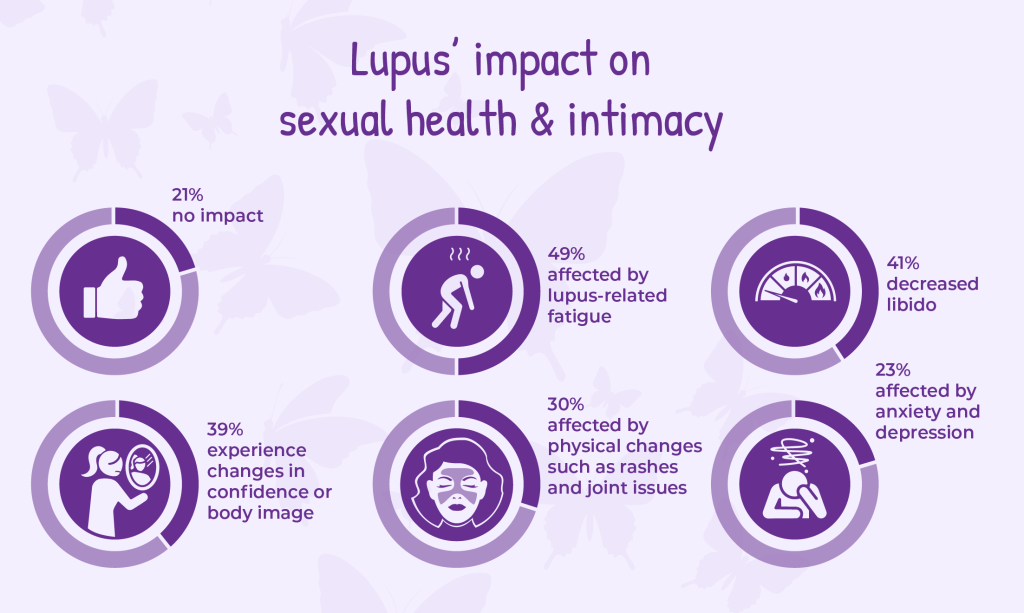
Only 21% of respondents reported that lupus had no impact on their sexual health. For the majority, lupus introduced a combination of physical, emotional, and relational challenges that shaped their experience of intimacy.
Fatigue emerged as the most reported factor, affecting nearly half of respondents (49%). This was followed by decreased libido (41%), changes in confidence or body image (39%), and physical changes such as rashes and joint issues (30%). Mental health also played a role, with 23% of respondents reporting that anxiety or depression affected their sexual wellbeing.
These challenges are interconnected. Respondents described how fatigue, pain, emotional distress, and medication effects interact, often making intimacy difficult to initiate or sustain. Some described withdrawing from relationships altogether. Others reflected uncertainty about how lupus, or co-existing conditions, were affecting their sexual health.

Sexual health is a major quality-of-life issue, yet it is almost never discussed in care
Patients are experiencing significant impacts on intimacy, confidence, and relationships, but these issues remain largely invisible within clinical encounters.
Despite the prevalence of these impacts, respondents indicated that sexual health is rarely discussed with their health care providers. This aligns with broader research showing that sexual health is frequently overlooked in chronic disease care, even when it significantly affects quality of life.³⁻⁴
What people told us
Respondents were asked to elaborate and many left detailed responses that have been grouped into major themes below:
Fatigue, pain and physical limitations
Many participants described difficulty engaging in intimacy due to fatigue, joint pain, or structural changes:
“I had to get hip replacements because I had to take prednisone and it cause[d] avascular Necrosis. It is difficult to take part in sexual activity for this reason.”
– Woman diagnosed with SLE between 11-20 years old living in a large urban centre
“Not currently, in times of relapse.”
– Woman diagnosed with SLE between 0-10 years old living in a rural or remote community
Medication effects and contraception challenges
Several respondents noted complications related to hormonal contraception or medication side effects:
“It made contraception more complicated.”
– Woman diagnosed with SLE between 11-20 years old living in a large urban centre
Avoidance of relationships or intimacy
Some respondents were not in relationships or avoided intimacy because of symptoms or stigma:
“Don’t have any relationships.”
– Woman diagnosed with lupus between 0-10 years old living in a large urban centre
“I am not in a relationship and I do not have an active sex life.”
– Woman diagnosed with SLE at age 61 years or older living in a large urban centre
“Lost interest in sex and sex is painful. Impacts my marriage a lot.”
– Woman diagnosed with SLE at age 61 years or older living in a large urban centre
Mental health and emotional wellbeing
Mental health challenges emerged as one of the most consistent and significant findings in the survey.
Eighty percent of respondents reported experiencing anxiety, depression, or insomnia related to their lupus. This underscores that mental health is not a secondary issue, but a central part of living with the disease.⁵⁻⁷
Respondents described a range of emotional challenges, including fear of flares, uncertainty about the future, and the cumulative burden of managing a chronic condition. These experiences often intersect with physical symptoms, making them difficult to separate.
The impact extends beyond individual wellbeing. More than half of respondents reported that lupus affected their relationships, with 20% describing a significant impact and 37% a moderate impact. These findings highlight the broader social and emotional consequences of the disease.
A gap between need and access
Despite the high prevalence of mental health challenges, nearly two-thirds of respondents (65%) had not sought out mental health professional in the past year. Among those who did, only a small proportion accessed psychologists (13%), counsellors (10%), social workers (7%), or psychiatrists (7%).
Barriers to care were also evident in qualitative responses, including geographic limitations and lack of available services.
“If I needed a mental health professional, the service is unavailable in my northern Ontario town.”
– Woman diagnosed with SLE between 21-30 years old living in a small-medium sized population centre
These findings suggest that while mental health needs are widespread, they are not systematically supported within lupus care.
Research reinforces this pattern.6 Studies have shown that anxiety and depression are highly prevalent among people living with lupus and are associated with poorer quality of life and disease outcomes.8
Mental health is often impacted by lupus, yet most patients receive no formal support

The survey findings point to a clear gap between patient need and access to care, highlighting the importance of integrating mental health into standard lupus care.
What these findings mean for lupus care
Across reproductive health, sexual health, and mental health, the survey reveals a consistent theme: areas that matter most to patients are not always reflected in how care is delivered.
Current models of care remain largely focused on physical disease activity. However, patients are also making complex decisions about pregnancy, navigating relationships, coping with emotional distress, and adapting to uncertainty.
When these experiences are not acknowledged or addressed, important needs remain unmet.
How can lupus survey findings guide us?
Survey responses point to a clear set of expectations.
Patients want care that reflects the full impact of lupus on their lives. They want earlier and more proactive conversations about reproductive health. They want sexual health to be recognized as part of overall wellbeing. They want mental health support to be accessible and integrated into care.
These are not additional services. They are essential components of patient-centred care. These findings align with evolving international recommendations emphasizing comprehensive, multidisciplinary lupus care.9-11
These findings provide a clear roadmap for improving lupus care in Canada, one that begins by aligning care with what patients are already telling us.
Conclusion
Part 2 highlights the broader, and often less visible, impacts of lupus. While advances in treatment have improved clinical outcomes, the survey findings show that important gaps remain in how the full experience of living with lupus can be addressed.
By grounding care in patient-reported experiences and unmet needs, there is an opportunity to improve both quality of life and health outcomes for people living with lupus in Canada.
References and supporting evidence
The following sources provide additional context and support for the findings presented in this report.
- Keeling SO, et al. Canadian recommendations for the management of systemic lupus erythematosus. Journal of Rheumatology. 2018;45(10):1426–1439.
- Clowse MEB, et al. Reproductive health discussions and care in systemic lupus erythematosus: patient and provider perspectives. Arthritis Care & Research. 2011;63(6):831–838.
- Yazdany J, et al. Lupus-related reproductive health experiences and needs of women of childbearing age: a qualitative study. Arthritis Care & Research. 2018;70(9):1340–1346.
- Tseng CE, et al. Sexual function in women with systemic lupus erythematosus. Lupus. 2011;20(8):815–822.
- Lupus Foundation of America. Lupus & You: Sexual Health and Intimacy Webinar Summary. 2023.
- Zhang L, et al. Prevalence of depression and anxiety in systemic lupus erythematosus: a systematic review and meta-analysis. BMC Psychiatry. 2017; 17:70.
- Mok CC, et al. Impact of anxiety and depression on disease activity and quality of life in patients with lupus nephritis. Lupus. 2019;28(11):1340–1347.
- Justin David Smith, Bo Pan, and Stephanie Keeling. Identifying the State of Mental Health Care in Canadian Adults with Systemic Lupus Erythematosus. The Journal of Rheumatology July 2025, jrheum.2025-0089; DOI: https://doi.org/10.3899/jrheum.2025-0089
- Lupus Canada. Mental Health and Lupus: A Global Perspective. 2022.
- Fanouriakis A, et al. 2023 update of the EULAR recommendations for the management of systemic lupus erythematosus. Annals of the Rheumatic Diseases. 2023;82(1):15–29.
- American College of Rheumatology. Guideline for the Management of Systemic Lupus Erythematosus. 2023.
Arthritis Consumer Experts and Lupus Canada express their deepest thanks to all survey participants who made this work possible. Their voices are essential in shaping a more responsive, equitable, and patient-centred approach to lupus care.
ACE remains committed to ensuring those voices continue to inform advocacy, policy, and care across Canada.
Listening to you
We hope you find this information of use. Please tell us what you think by writing to us or emailing us at feedback@jointhealth.org. Through your ongoing and active participation, ACE can make its work more relevant to all Canadians living with arthritis.
Update your email or postal address
Please let us know of any changes by contacting ACE at feedback@jointhealth.org. This will ensure that you continue to receive your free email or print copy of JointHealth™ insight.
Arthritis Consumer Experts (ACE)
Who We Are
Arthritis Consumer Experts (ACE) and its team members acknowledge that they gather and work on the traditional, ancestral and unceded territory of the Coast Salish peoples -ʷməθkʷəy̓əm (Musqueam), Sḵwx̱wú7mesh (Squamish), and Səl̓ílwətaʔ/Selilwitulh (Tsleil-Waututh) Nations.
Arthritis Consumer Experts (ACE) operates as a non-profit and provides free research based education and information to Canadians with arthritis. We help (em)power people living with all forms of arthritis to take control of their disease and to take action in healthcare and research decision making. ACE activities are guided by its members and led by people with arthritis, scientific and medical experts on the ACE Advisory Board. To learn more about ACE, visit www.jointhealth.org
Disclosures
Over the past 12 months, ACE received financial and in-kind support from: Amgen Canada, Arthritis Research Canada, Arthritis Society Canada, Biogen Canada, Canadian Biosimilars Forum, Canadian Rheumatology Association, Celltrion Healthcare Canada, JAMP Pharma, Novartis Canada, Organon Canada, Pfizer Canada, Sandoz Canada, UCB Canada, and the University of British Columbia.
ACE also received unsolicited donations from its community members (people with arthritis) across Canada.
ACE thanks funders for their support to help the nearly 6 million Canadians living with osteoarthritis, rheumatoid arthritis, psoriatic arthritis, ankylosing spondylitis and the many other forms of the disease.
Disclaimer
The material contained on this website is provided for general information only. This website should not be relied on to suggest a course of treatment for a particular individual or as a substitute for consultation with qualified health professionals who are familiar with your individual medical needs. Should you have any healthcare related questions, you should contact your physician. You should never disregard medical advice or delay in seeking it because of something you have read on this or any website.
This site may provide links to other Internet sites only for the convenience of World Wide Web users. ACE is not responsible for the availability or content of these external sites, nor does ACE endorse, warrant or guarantee the products, services or information described or offered at these other Internet sites.
Although the information presented on this website is believed to be accurate at the time it is posted, this website could include inaccuracies, typographical errors or out-of-date information. This website may be changed at any time without prior notice.